The time trail
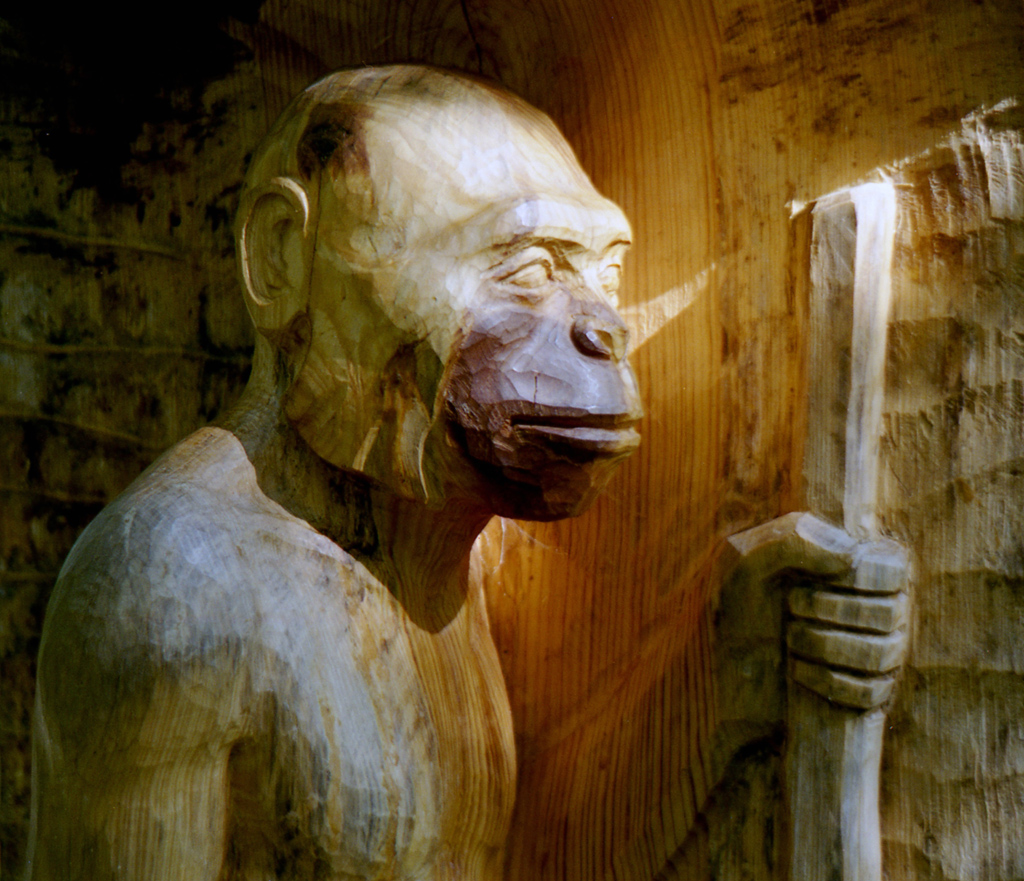
At the start of this millennium, the Swiss city of Neuchâtel created a trail through time in the nearby woods – Le Sentier du Temps. The starting point was intended to mark the formation of our planet Earth, and the end point our present day. Each one-metre step represented one million years, making the trail 4.5 kilometres long. Key ‘moments’ in the evolution of life on Earth were marked along the route and illustrated by 17 wooden sculptures. For the first four kilometres, there was hardly anything to see. All the sculptures were concentrated within the final 600 metres, starting with the Redlichia, tiny creatures of the trilobite genus that lived between 600 and 505 million years ago as one of the earliest forms of animal life on Earth. 500 million years later, almost at the end of the path, we come to the Australopithecus, pictured above. It is one of the earliest hominids, which lived during the Pliocene epoch, 5–2 million years ago. The sculpture depicts it walking upright with a stick in its hand. This already makes it look quite human. We find ourselves at the very beginning of humanity’s journey on Earth, which covers the last 5 metres of the 4.5-kilometre-long trail.
In the photograph below, we pause to reflect on a much earlier stage in evolution, about 300 metres before the end of the path. This is the Carboniferous period, from 360 to 286 million years ago. The warm and humid climate of that time was conducive to lush vegetation, in which large insects flourished (Meganeura, with a wingspan of up to 70 cm), as did the first reptiles (Hylonomus).
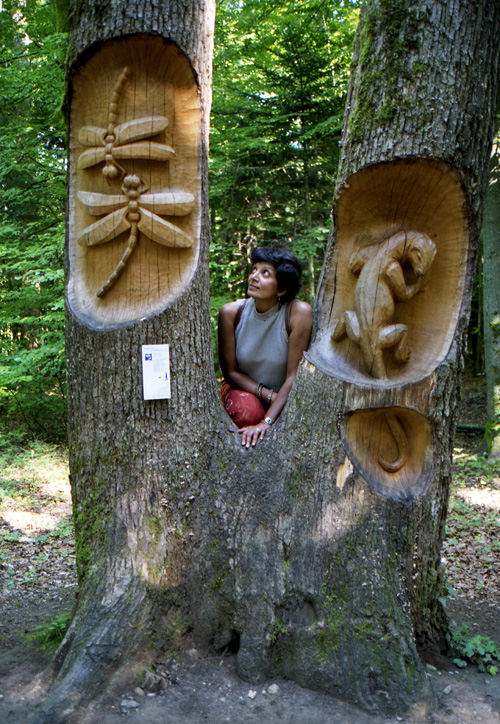
Between Meganeura and Hylonomus, we see a modern-day example of Homo sapiens: a magnificent woman of Indian descent, and the love of the second half of my life.
Photo of the week: Australopithecus, Le Sentier du Temps, Neuchâtel, Switzerland, 2001


Leave a Reply